-
Thai pie recipe
March 16, 2026
Thai pie is essentially Québécois tourtière pie with Thai aromatics. I came up with the idea because I wanted to make tourtière pie but did not have all of the spices required by this recipe. I did happen to have lemongrass and kaffir lime leaves, and so the thai pie was born.
Keep reading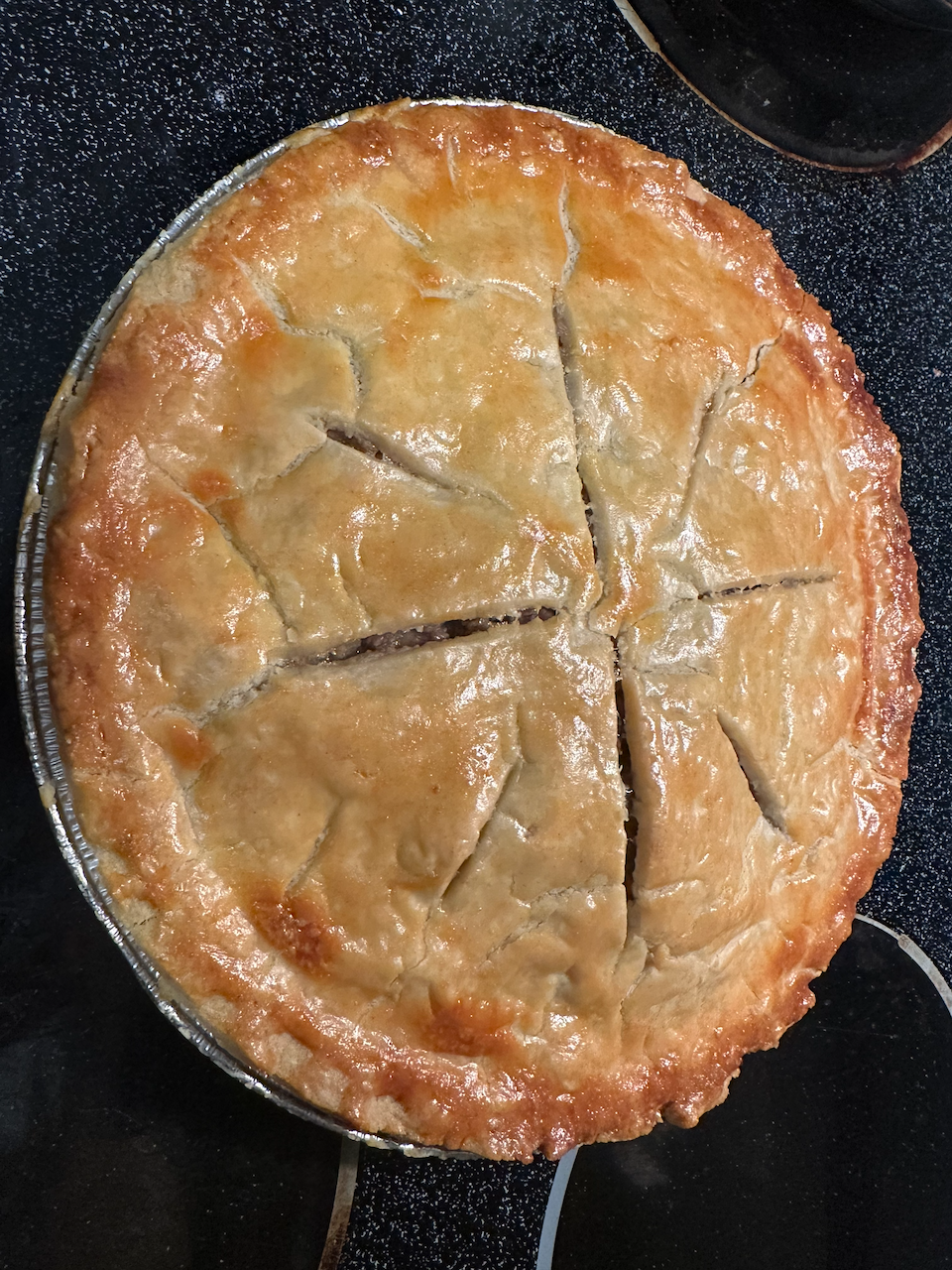
A just-baked thai pie
-
Education after ChatGPT
January 4, 2026
A few times now, I have heard people bring up Socrates' suspicion of writing in the context of the impact of AI on learning. As a defense of AI, the point is that people (even wise people like Socrates) have long been concerned about the impact of technologies on the human mind, and in hindsight these concerns usually look silly.
AI fears may be partly a moral panic. Still, AI is having an impact on learning in specific and undeniable ways. ChatGPT can write an essay better than many high school and university students, it seems, and many students are all too happy to outsource their essay writing–and critical thinking–to it. Teachers are struggling to prove that essays have been written by AI, and so the value of the whole rigmarole of essay writing and grading seems to be in question.
Socrates thought that dialogue was superior to reading and writing for the development of the mind. In 2026, when everything is being thrown into question, this old idea might have fresh salience. In the same way that calculators made mental math (somewhat) obsolete, maybe LLMs, essentially information regurgitation machines, have made this standard part of education obsolete also. Should classrooms return to the Socratic method of education? I have to admit I love to imagine it, and I probably would have liked for my own education to have included more open-ended dialogue and less information regurgitation.
I can’t say exactly how this would work and scale. One benefit of written essays is that they can be graded en masse. Maybe traditional grading systems will also have to be reworked in response to the AI disruption. What I do believe strongly is that nothing should be off the table.
Keep reading -
Frontend State Beyond useState
December 19, 2025
At work I often encounter frontend state management that is overly complex and error-prone. Some examples:
- Fetching some data from the server, then maintaining a copy of that data in a global store like Redux
- Manually managing form state with React’s useState hook
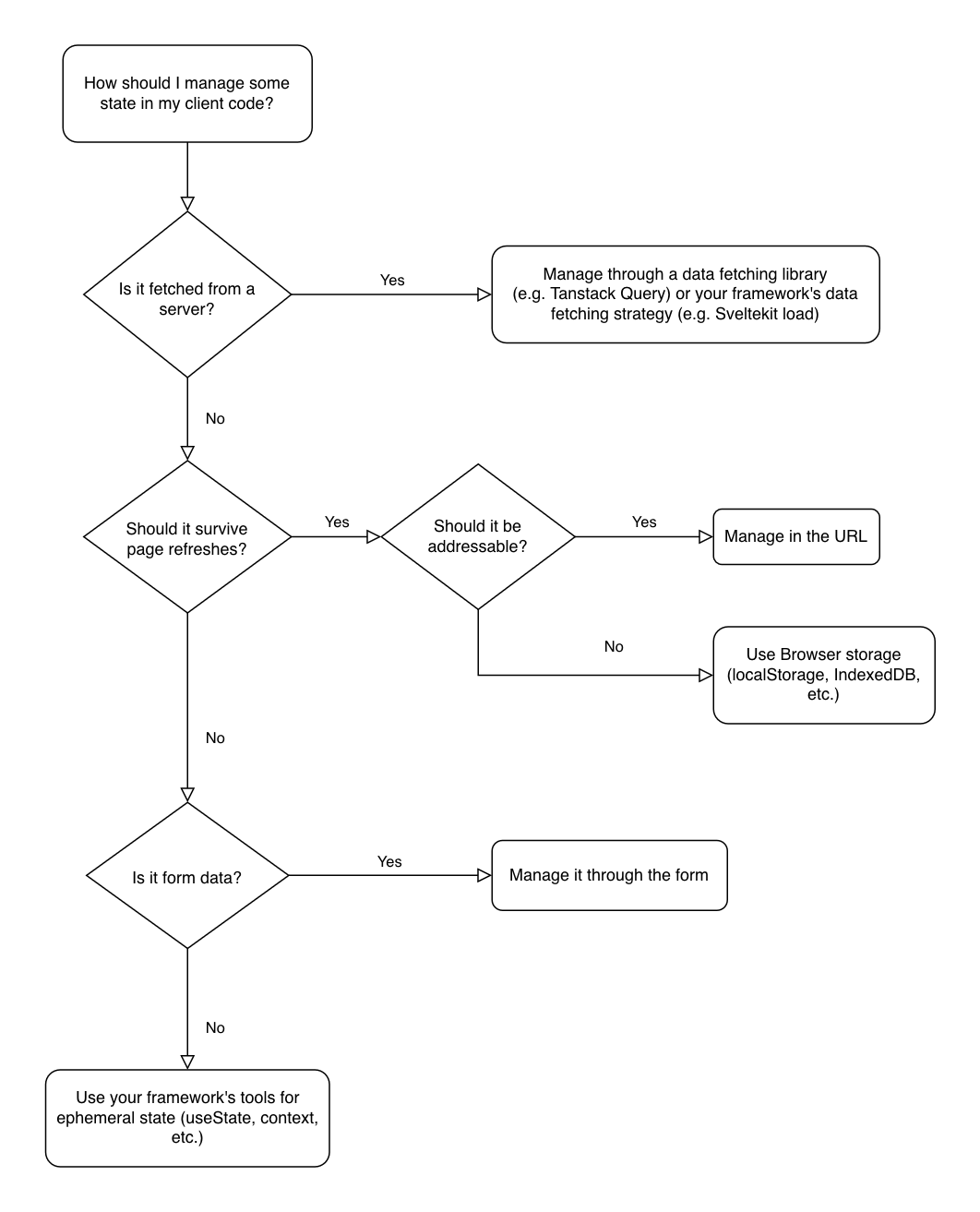
Sometimes, state is used when URL search params should be used instead. In modern frontend programming, there is usually a right and wrong way to manage some state, depending on its purpose and qualities. This flow chart should be helpful when making a decision about how to manage some frontend state:
Server Data
Modern javascript frameworks come with data fetching solutions. For example, SvelteKit load. For a stand-alone library, I like Tanstack Query, which manages fetching, deduplication, invalidation, and more. There is absolutely no reason for you to be managing server data manually on the client, you will save yourself many headaches by using a framework or a data fetching library.
What is addressability
Web pages are accessed using Universal Resource Locators, or URLs.1 As implied by the name, the URL points to a specific resource provided by your website. In other words, it is an address: a way to communicate about where something is. When deciding if some state should be addressable, ask yourself: Should this state persist if I bookmark this page for later? Or if I share the link to this page with a friend? For example, consider a page that shows a list or grid of similar items, where the user can filter the items based on certain qualities. Frontend developers often use state to store filter selections, but using the URL’s search parameters is preferable for addressability. Imagine an ecommerce site that sells fruit. A URL for this site might look like:
example.com/shop/apples?colour=red. If I share this link with my friend, they will know I meant to show them red apples. Other examples of state that should be addressable include:- Pagination
- Search queries
- Addressing a specific tab or part of a page. Wikipedia does this well. E.g.
https://en.wikipedia.org/wiki/Uniform_Resource_Identifier#Syntax, this link specifically addresses the section about URL syntax. - Linking to a form with some data pre-filled (e.g.
foo.com/register?country=CAN) - Selections (e.g.
inbox?selected=msg_456)
Other benefits of addressability:
- Browser back/forward buttons work as expected
- Search engines can index filtered pages
- Analytics can track which filters users actually use
Avoid putting sensitive data in URLs. URLs will end up in the user’s browser history, and in your logs.
Form Data
Similar to server data, modern frameworks have idiomatic solutions for form management. If you aren’t using a framework, use a form library like react-hook-form. Managing form state manually is likely to result in overly verbose code, while using a library or framework will result in more declarative, readable code. These tools will also help you to follow best practices for semantic HTML.
When to use Forms
<form>should be used when your user needs to submit input. Often, this means they are mutating some data. For example, to allow a user to update their address, you would show them an address form. Most websites use forms for search inputs. While you should consider using a form any time a user is entering input into your website, you might not be able to use forms in all cases. For example, a rich text editor like an email composer might be awkward to implement as a form. In general, a form should be the first tool of choice for collecting user input.2
1. I know URL officially stands for uniform resource locator, but "universal" works better for the point.
2. MDN has a good guide on form building.
Keep reading -
Book Review: Cod: A Biography of the Fish that Changed the World
October 9, 2025

Atlantic cod. Public Domain, Link
The fisherman of Newfoundland never thought that the cod stocks could run out. With the benefit of hindsight, their folly seems obvious, but as a fisherman in the 20th century, it would be hard to imagine the extinction of cod. Cod had been plentiful off the coast of Newfoundland since Europeans began fishing it in the 1490s (this book speculates that Europeans--Basques and the British--were fishing in North America before Columbus sailed there in 1491, though this can't be proven). Cod lay 9000 eggs at a time. They had disappeared in certain locations many times before, only to reappear somewhere else. It was not thought that humans could possibly overfish cod to the point of depletion.
The depletion of the Grand Banks (Newfoundland) cod fishery in the late 1980s could be called a black swan event. As someone who was born after the cod fishing moratorium was effected in 1992, reading this book helped me to appreciate just how surprising this was. The most economically important fish of all time, which had for hundreds of years been the main staple of many Europeans’ diets and contributed to the European settlement of North America, was gone.
Keep reading -
Book Review: Devil Take the Hindmost
October 8, 2025
Men, it has been well said, think in herds; it will be seen that they go mad in herds, while they only recover their senses slowly, one by one.
― Charles MacKay, Extraordinary Popular Delusions and the Madness of Crowds (1841)
Lately I've been reading the works of Edward Chancellor. In February of this year I read The Price of Time, a book about how interest rates affect the economy and the business cycle. It is essentially a critique of central banks' control of interest rates, and the economic distortions caused thereby. I also read Capital Returns, which he edited and wrote the forward to, have listened to his podcast, and read some of his articles published in Reuters and elsewhere. All of this reading combined to give me the impression of Chancellor as a staunch libertarian capitalist, so I was surprised by his first book, Devil Take the Hindmost, which seems ambivalent about capitalism, or at least capitalism's ability to rationally allocate resources.
Keep reading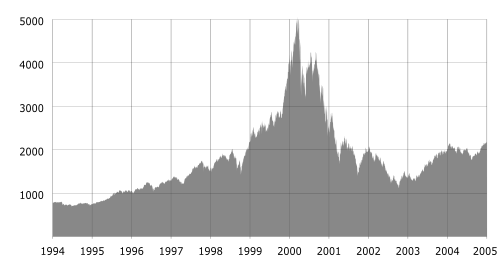
The NASDAQ index from 1994-2004, showing the dot-com bubble.